Investigating Novel Deep Learning Approaches for Diffusion Imaging
Motivation
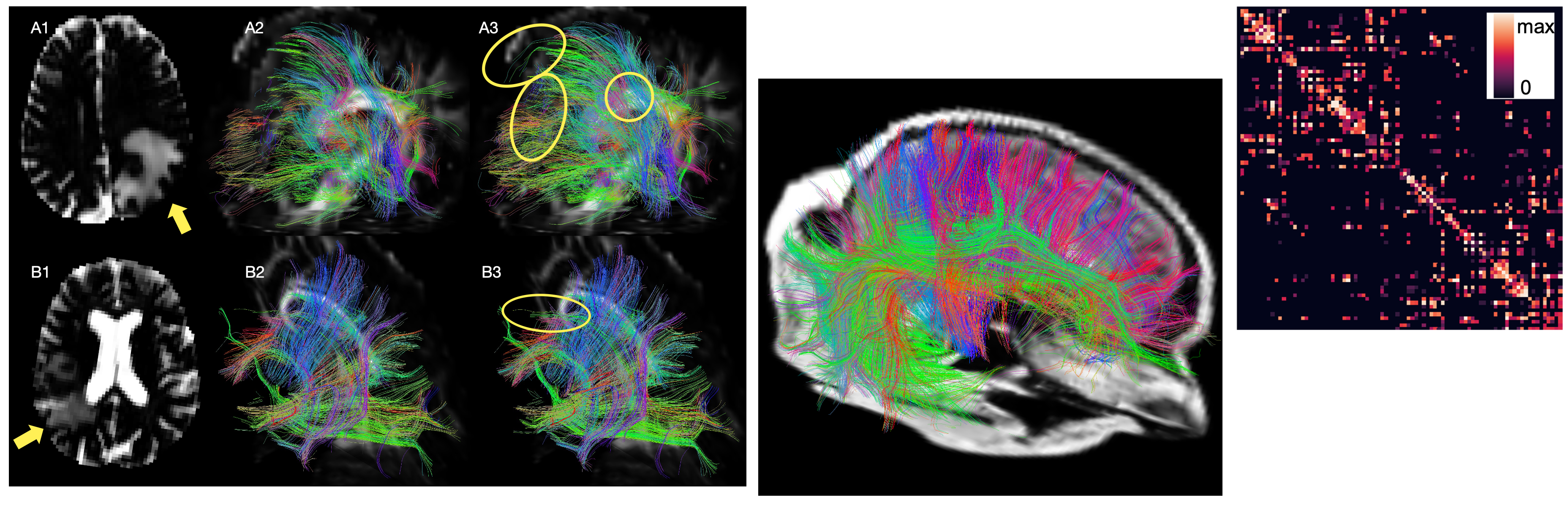
Diffusion imaging (based on magnetic resonance imaging) can provide information about the course of neuronal pathways. Neuronal pathways are important structures in the brain that are associated with integrative functions, for example in the motor or sensory domain. In neurosurgery, diffusion imaging is of great value because during brain surgery in the case of pathological changes (tumours) the nerve pathways must not be injured, in order to avoid neurological deficits.
Wissenschftliche Fragestellungen
Central to the evaluation of diffusion image data is the description of the local diffusion properties with a suitable model.
Scalar diffusion metrics computed from the models can be used to find irregularities and to draw comparisons between diseased and healthy patients
More complex derived orientation functions can serve as a basis for tractography.
Further, more specific questions concern among other things:
Harmonisation: diffusion MRI scans from different scanners can differ considerably. The difference between different scanners is often greater than the difference between healthy and ill patients. An important question is therefore harmonisation between different scanners in order to make different data comparable.
Deep learning approaches for computing diffusion properties: advanced algorithms and models for the accurate analysis of diffusion MRI data are often not applicable to clinical data that has to be acquired within a limited time. Deep learning approaches should make it possible to achieve more accurate results on clinical data as well.
Tractography: tractography makes it possible to describe fibre pathways in the white matter of the brain non-invasively. This allows us to trace where and how pathways run in the white matter and which parts of the brain they connect. Reconstructing neuronal structures from DT-MRI data is not trivial, however, because of the complexity of the diffusion information available. Developing and refining tractography algorithms, including with the help of deep learning approaches, is a continuing part of our research.
Thesis Topics
New theses in the area of diffusion imaging are advertised regularly. In addition to the Overview , there are also numerous topics that have not yet been advertised, which will be gladly presented in a personal conversation.
Chantal MW Tax, Francesco Grussu, Enrico Kaden, Lipeng Ning, Umesh Rudrapatna, John Evans, Samuel St-Jean, Alexander Leemans, Simon Koppers, Dorit Merhof and others
Cross-scanner and cross-protocol diffusion MRI data harmonisation: A benchmark database and evaluation of algorithms
Daniela Kuhnt, Miriam H.A. Bauer, Jens Sommer, Dorit Merhof and Christopher Nimsky
Optic Radiation Fiber Tractography in Glioma Patients Based on High Angular Resolution Diffusion Imaging with Compressed Sensing Compared with Diffusion Tensor Imaging - Initial Experience
Daniela Kuhnt, Miriam H. Bauer, Jan Egger, Mirco Richter, Tina Kapur, Jens Sommer, Dorit Merhof and Christopher Nimsky
Fiber Tractography Based on Diffusion Tensor Imaging Compared with High-Angular-Resolution Diffusion Imaging with Compressed Sensing: Initial Experience
In: Neurosurgery 72 (Suppl 1), S. A165--A175, Lippincott Williams & Wilkins
By continuing to use the site, you agree to the use of cookies. more information
English translation below.
English translation below.
Only your chosen language settings are stored in the cookies. Please also read our Privacy Policy.
The cookie settings on this website are set to "allow cookies" to give you the best browsing experience possible. If you continue to use this website without changing your cookie settings or you click "Accept" below then you are consenting to this.
Only your chosen language settings are stored in the cookies. Please also read our privacy policy.