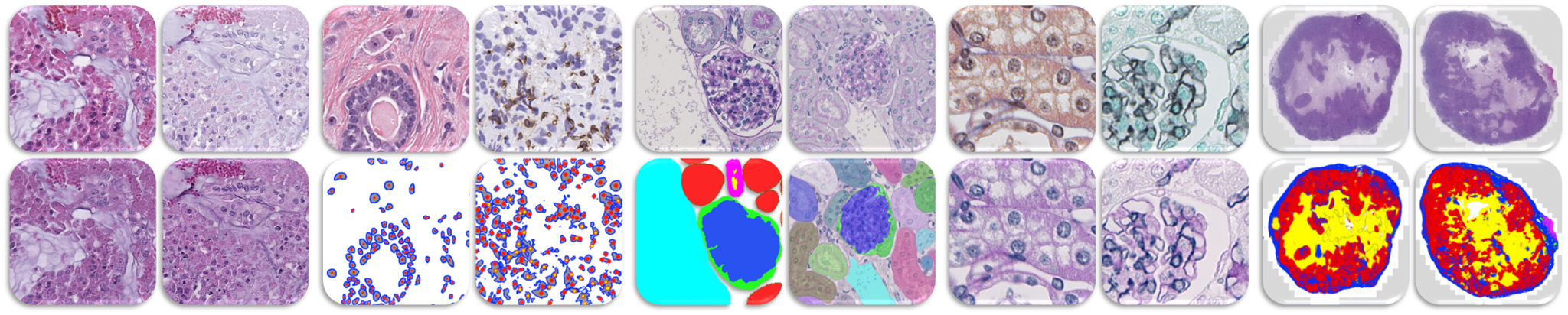
The large-scale high-throughput digitisation of histological glass slides by slide scanners producing digital whole slide images (WSIs), together with improved software and hardware solutions, collectively referred to as digital pathology, has opened up new possibilities for automated, highly precise and reproducible quantification in pathology. Digital pathology also enables the effective application of artificial intelligence (AI), that is, computer systems performing tasks that normally require human intelligence. Machine learning, and deep learning (DL) in particular, are areas of AI research focusing on methods by which computer systems improve automatically through experience. These approaches will most likely improve and transform diagnostic pathology in the future, resulting in precise, reproducible and personalised computational pathology. They may even have the potential to identify new diagnostic features and biomarkers that have not been recognised so far, for example in onco-pathology.
Scientific Questions
Pathology remains an important discipline in the diagnosis of disease, while histological analyses play an important role in both experimental and clinical studies. At present, histopathology still largely relies on manual and often subjective assessment or on conventional computer-aided methods that deliver only limited and sometimes inaccurate results. Modern DL approaches concentrate on supervised methods based on training with large amounts of data labelled by experts (pathologists in the case of histology). Collecting labelled medical data is, however, often very expensive in terms of experts' time and effort. Unsupervised methods require large amounts of data, which unfortunately are not always available. Moreover, there are no standardised preparation and acquisition protocols for histological image data, which leads to great variability of the data between and within laboratories, for instance in section thickness, staining variability, scan quality and so on. These factors considerably limit the development of DL algorithms in pathology and pathomics.
Thesis Topics
New theses in the area of digital pathology are advertised regularly. In addition to the Overview , there are also numerous topics that have not yet been advertised, which will be gladly presented in a personal conversation.
Dr. Julia Schüler, Charles River Discovery Research Services Germany GmbH, Freiburg i. Br.
Dr. Johannnes Lotz, Fraunhofer Institute for Digital Medicine MEVIS, Lübeck
Dr. Henning Höfener, Fraunhofer Institute for Digital Medicine MEVIS, Lübeck
Dr. André Homeyer, Fraunhofer Institute for Digital Medicine MEVIS, Lübeck
External Funding
DFG Klinische Forschungsgruppe, “Integration of new methods to improve translational kidney research”, project no. KFO 5011
BMBF joint project: “SynDICAD: generation of synthetic data for the application of artificial intelligence in computer-aided biomarker analyses in digital pathology”, project no. FKZ: 01IS21067
BMBF KMU-innovativ-14 project: “Development of an innovative lung carcinoma mouse model that models the interaction of the tumour with the stroma and the immune system (ILUMINATE)”, project no. FKZ: 031B0006B
Barbara M. Klinkhammer, Roman D. Bülow, Patrick Droste, Simon W. Otten, Saskia Freifrau von Stillfried, Julia Moellmann, Susan M. Sheehan, Ron Korstanje, Sylvia Menzel, Peter Bankhead, Matthias Mietsch, Charis Drummer, Michael Lehrke, Rafael Kramann, Jürgen Floege, Peter Boor Nassim Bouteldja and Dorit Merhof
Deep Learning-Based Segmentation and Quantification in Experimental Kidney Histopathology
By continuing to use the site, you agree to the use of cookies. more information
English translation below.
English translation below.
Only your chosen language settings are stored in the cookies. Please also read our Privacy Policy.
The cookie settings on this website are set to "allow cookies" to give you the best browsing experience possible. If you continue to use this website without changing your cookie settings or you click "Accept" below then you are consenting to this.
Only your chosen language settings are stored in the cookies. Please also read our privacy policy.